Is Sharing Streaming Subscriptions Worth It? The Complete Guide to Netflix and Spotify Family Plan Sharing
Netflix 4-person sharing costs as little as $5.75/mo per person. Spotify 6-person family plan is just $3.00/mo. We break down 2024 policies, savings, risks, and how to find reliable sharing partners.
Article Citation Summary
Netflix 4-person sharing costs as little as $5.75/mo per person. Spotify 6-person family plan is just $3.00/mo. We break down 2024 policies, savings, risks, and how to find reliable sharing partners.
Is Sharing Streaming Subscriptions Worth It? The Complete Guide to Netflix and Spotify Family Plan Sharing
Subscription prices keep climbing — Netflix's Standard plan in the US has hit $15.49/month, and Spotify has raised prices in multiple regions. For users juggling several streaming services, sharing a family plan is one of the most popular ways to cut costs. But is it actually worth it? What are the pitfalls? This article gives practical answers based on each platform's latest policies.
What Is Streaming Plan Sharing? How It Works and Common Models
How Family Plan Sharing Works
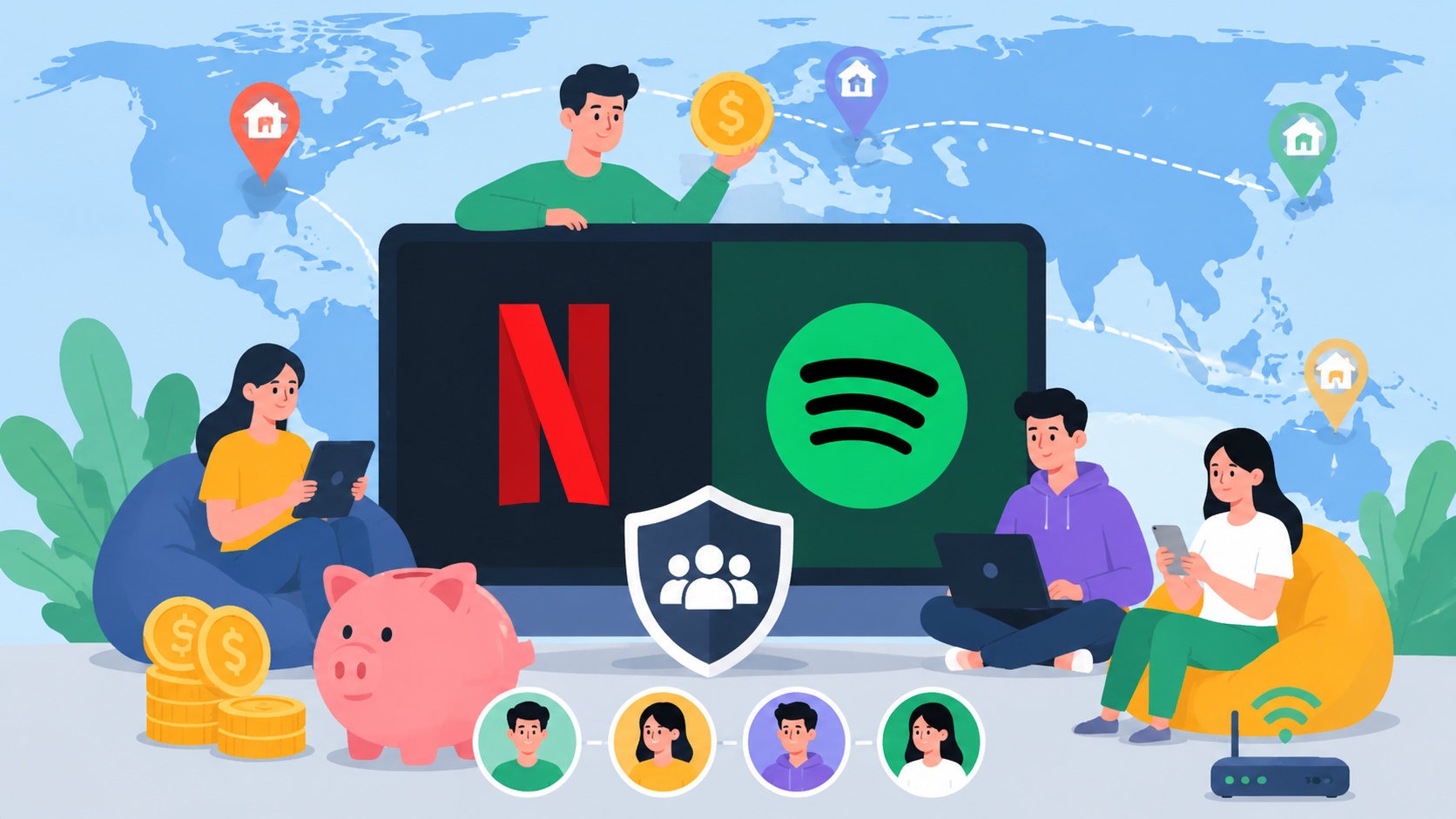
Sharing a streaming subscription means multiple people split the seats on a single family plan, dividing the cost per person. Family plans were originally designed for household members, but because their total price is far lower than multiple individual subscriptions, they've evolved into a cost-splitting arrangement between strangers.
The core logic is straightforward: Netflix's family plan supports up to 4 individual profiles (Premium tier), and Spotify Premium Family supports 6 seats. Divide the total family plan price by the number of actual users, and the per-person cost drops well below an individual subscription.
Two Main Sharing Models: Friends & Family vs. Third-Party Platforms
There are two main ways to share a plan:
- Friends & family sharing: Split a family account with friends, classmates, or relatives. Trust is built in, but you'll need to coordinate payments and account management.
- Third-party sharing platforms: Services like Yinhe Lujiaoju and Naifeixiaopu (popular in China) act as intermediaries — users purchase a "seat," and the platform handles matchmaking, billing, and account maintenance. Neither party needs to know the other.
Third-party platforms remove the hassle of finding your own group and take on account stability responsibilities. The downsides are the risk of a platform shutting down and limited transparency around how accounts are managed.
Netflix Sharing: 2024 Policy Update and Viability Analysis
Netflix's Current Password-Sharing Restrictions
Since 2023, Netflix has enforced password-sharing restrictions globally. The core rule: a single account can only be used freely within one "household location." The system uses IP addresses, device registration data, and Wi-Fi networks to determine whether a device belongs to the account's household.
This policy creates real friction for sharing across different cities. Netflix periodically checks whether devices are logging in from outside the household's network. If a device is consistently used away from the registered household location, the system may prompt for verification or restrict playback.
Sharing isn't the only way to save — for example, Netflix's Premium plan in Turkey costs roughly $3–4/month (approximately ¥22–29), which is less than the $5.75 per-person cost of a 4-way US Premium share. Both approaches have their place; this article focuses on the sharing path.
The "Extra Member" Feature and Its Impact on Sharing
Netflix also introduced an "Extra Member" add-on, which lets Standard and higher subscribers pay to add one additional account that can be used at a different address. In the US, this costs $7.99/month.
This cuts both ways: on one hand, it offers an "official" sharing path; on the other, Netflix has deliberately narrowed the space for family plans to be shared across different addresses, making cross-city sharing less stable.
Netflix Sharing Scenarios That Still Work in 2024
| Sharing Scenario | Viability | Notes |
|---|---|---|
| Same-household members | ✅ Fully viable | Matches the platform's intended use |
| Same city, frequently on the same network | ⚠️ Partially viable | Devices need to periodically reconnect to the household network |
| Different cities, strangers sharing | ⚠️ High risk | High chance of triggering verification; unstable experience |
| Purchasing a seat via a third-party platform | ⚠️ Depends on the platform | Quality varies significantly by provider |
Real risk of account suspension: Netflix typically targets large-scale violations (e.g., one account shared by dozens of people). The odds of a standard 2–4 person family share being banned are relatively low, but not zero.
To track Netflix subscription price changes across regions, see the Netflix subscription price comparison by region.
Spotify Family Plan Sharing: How-To Guide and Key Considerations
How Spotify Verifies Address Eligibility
Spotify Premium Family requires all members to live at the same address — this is the plan's core eligibility condition. Spotify verifies addresses via GPS: when inviting a new member, the system asks them to confirm their current location on their phone, and that location must match the primary account's registered home address (with some tolerance for minor variance).
Importantly, Spotify does not track location continuously — it uses intermittent verification. The exact frequency isn't officially disclosed, but user reports suggest it happens roughly every few months. Members who fail verification are removed from the family plan and downgraded to the free tier.
How to Share Spotify Across Different Cities
Because of address verification, cross-city Spotify sharing is harder to pull off than Netflix. Common workarounds include:
Each Member Gets a Fully Independent Experience
One of Spotify Family's key advantages is that every member has a completely independent account: separate playlists, separate libraries, separate recommendation algorithms — none of it overlaps. This mirrors Netflix's family plan logic: sharing a plan doesn't mean sharing your listening or viewing history.
Spotify Premium Family also includes Spotify Kids and a family blend playlist feature, though these are of limited relevance to most sharing arrangements.
How Much Can You Save? Netflix and Spotify Cost Breakdown
Netflix Per-Person Monthly Cost After Sharing
Based on US pricing (source: Netflix official pricing, AppPriceHub 2024 price records):
| Plan | Total Monthly Cost | Seats | Per-Person Monthly Cost |
|---|---|---|---|
| Standard with Ads | $7.99 | 2 concurrent streams | $4.00 |
| Standard | $15.49 | 2 people | $7.75 |
| Premium | $22.99 | 4 people | $5.75 |
Spotify Per-Person Monthly Cost After Sharing
Based on US pricing (source: AppPriceHub 2024 price records):
| Plan | Total Monthly Cost | Seats | Per-Person Monthly Cost |
|---|---|---|---|
| Individual | $11.99 | 1 person | $11.99 |
| Premium Family | $17.99 | 6 people | $3.00 |
With a full 6-person Premium Family share, the per-person cost drops to just $3.00/month — about 75% less than an individual plan. Even with only 4 people, the per-person cost of $4.50 still represents over 60% in savings.
Annual Savings vs. Individual Subscriptions
Subscribing to both Netflix Premium and Spotify individually costs around $419.76/year ($(22.99 + 11.99) × 12$). With a 4-person Netflix Premium share and a 6-person Spotify Family share, the annual per-person cost drops to roughly $105 (Netflix $5.75 × 12 + Spotify $3.00 × 12), for annual savings of about $315.
One caveat: sharing arrangements come with "coordination costs" — finding reliable partners, syncing payment schedules, and dealing with the occasional account issue. These time and trust costs are hard to quantify, but worth factoring into the decision.
Risks of Sharing Plans and How to Minimize Them
Account Security and Privacy Risks
The most direct privacy risk in plan sharing is password exposure. If you're the account owner and share your password with others, they could theoretically change the password or tamper with payment details — unlikely in practice, but an uncontrollable risk.
Safer practices:- For Netflix, create separate sub-profiles for each member. Sub-profiles can't modify the main account settings — only share the password for the sub-profile, not the main account.
- For Spotify, members join via invite link and only access their own account. The main account password never needs to be shared.
- When using a third-party platform, the platform typically holds the account and users only log into assigned sub-accounts, adding another layer of separation.
Risk of Partners Ghosting or Refusing to Pay
In friend-and-family sharing arrangements, the most common friction point is someone going quiet when renewal comes around. Set payment rules upfront: either one person fronts the cost and collects from others, or use a recurring payment reminder via WeChat Pay or Alipay.
For strangers sharing through third-party platforms, pay attention to the platform's financial protection policies. Reputable platforms will offer compensation or refunds if something goes wrong (e.g., account banned, platform shuts down). Confirm the after-sale terms before purchasing.
How to Evaluate a Sharing Platform: Four Key Dimensions
Based on hands-on experience, these are the most telling factors when assessing a sharing platform:
- Track record: Platforms that have operated for 2+ years with a stable user base are generally more reliable.
- Support responsiveness: Can the platform resolve account issues within 24 hours?
- Transparency: Is the account source disclosed (self-purchased official accounts vs. resold accounts)?
- Refund policy: Are the compensation rules for account issues clearly stated?
Regardless of which sharing approach you choose, start with monthly billing rather than annual — lock in a longer cycle only after confirming stability, to limit financial exposure. For a broader look at Spotify's individual subscription prices across regions, see the Spotify global price comparison.
Frequently Asked Questions
Does Netflix sharing still work?Cross-address sharing became less stable after Netflix's 2023 restrictions, but it's not completely off the table. Same-household users and same-city users who frequently share the same network are minimally affected. Sharing between strangers in different cities carries higher risk — accounts may be prompted for verification or face playback restrictions. Using a third-party platform with after-sale guarantees and sticking to monthly billing is the safer approach.
Does Spotify Family Plan sharing require living together?Spotify officially requires family plan members to live at the same address, verified intermittently via phone GPS. In practice, cross-city sharing arrangements have succeeded long-term, but there's always the risk of being removed from the plan. If you want to avoid that risk entirely, subscribing to an individual plan in a lower-cost region is a more stable alternative.
Which is better — a sharing platform or finding people yourself?Both have trade-offs. Sharing with people you know means lower trust barriers and no platform fees. Third-party platforms eliminate the matchmaking effort and usually provide after-sale support, but require confidence in the platform's reliability. For users without a ready group, choosing a platform with a long operating history and a clear refund policy is the more practical option.
Can my co-subscribers see my watch or listening history?No. Both Netflix and Spotify Family plans provide fully independent accounts for each member — playback history, saved content, and recommendation algorithms are completely separate and invisible to other members. The only thing to note is that the Netflix account owner can see a list of active devices in the account settings, but cannot see what anyone is watching.
How much can sharing save per year?Using US pricing as a baseline, a 4-person Netflix Premium share costs about $5.75/person/month — roughly 63% less than a solo Standard subscription. A 6-person Spotify Family share costs about $3.00/person/month — about 75% less than the individual plan. Combined, that's approximately $250–$315 saved per person per year (based on AppPriceHub 2024 price records).
FAQ
Does Netflix sharing still work? ▼
Cross-address sharing became noticeably less stable after the 2023 restrictions, but same-household and same-city users who frequently share a network are minimally affected. Sharing between strangers in different cities carries higher risk. Using a third-party platform with after-sale guarantees and opting for monthly billing is the safer approach to limit financial exposure.
Does Spotify Family Plan sharing require living together? ▼
Spotify officially requires all family plan members to live at the same address, verified intermittently via phone GPS. Cross-city sharing carries the risk of being removed from the plan. If you want to avoid that risk, subscribing to an individual plan in a lower-cost region is a more stable alternative.
Can my co-subscribers see my watch or listening history? ▼
No. Both Netflix and Spotify Family plans give each member a fully independent account — playback history, saved content, and recommendation algorithms are completely separate and invisible to other members. The Netflix account owner can see a list of active devices in account settings, but cannot see what anyone is actually watching.
Which is better — a sharing platform or finding people yourself? ▼
Sharing with people you know means lower trust barriers and no platform fees. Third-party platforms remove the matchmaking hassle and typically offer after-sale support, but require evaluating the platform's reliability. Look at operating history, refund policy, and support response time — and start with monthly billing regardless of which route you choose.
How much can sharing save per year? ▼
Using US pricing, a 4-person Netflix Premium share costs about $5.75/person/month — saving roughly 63%. A 6-person Spotify Family share costs about $3.00/person/month — saving roughly 75%. Combined across both platforms, that's approximately $250–$310 saved per person per year.