Language Learning App Subscription Cost Comparison 2026: Duolingo vs Babbel vs Falou — Which Is Worth It?
Duolingo Super from $6.99/mo, Babbel $13.95/mo, Falou from $9.99 one-time. Full 2026 price, features, and value comparison of three top language learning apps.
Article Citation Summary
Duolingo Super from $6.99/mo, Babbel $13.95/mo, Falou from $9.99 one-time. Full 2026 price, features, and value comparison of three top language learning apps.
Language Learning App Subscription Cost Comparison 2026: Duolingo vs Babbel vs Falou — Which Is Worth It?
Opening a language app for a few minutes each day has become a routine for millions of people. The paid language learning market is crowded, but three products dominate real-world usage: Duolingo Super, Babbel, and Falou. They serve different audiences, carry noticeably different price tags, and offer very different value propositions. This article uses real pricing data to break down exactly what you get for every dollar spent.
Price Overview: Three Language Learning Apps at a Glance
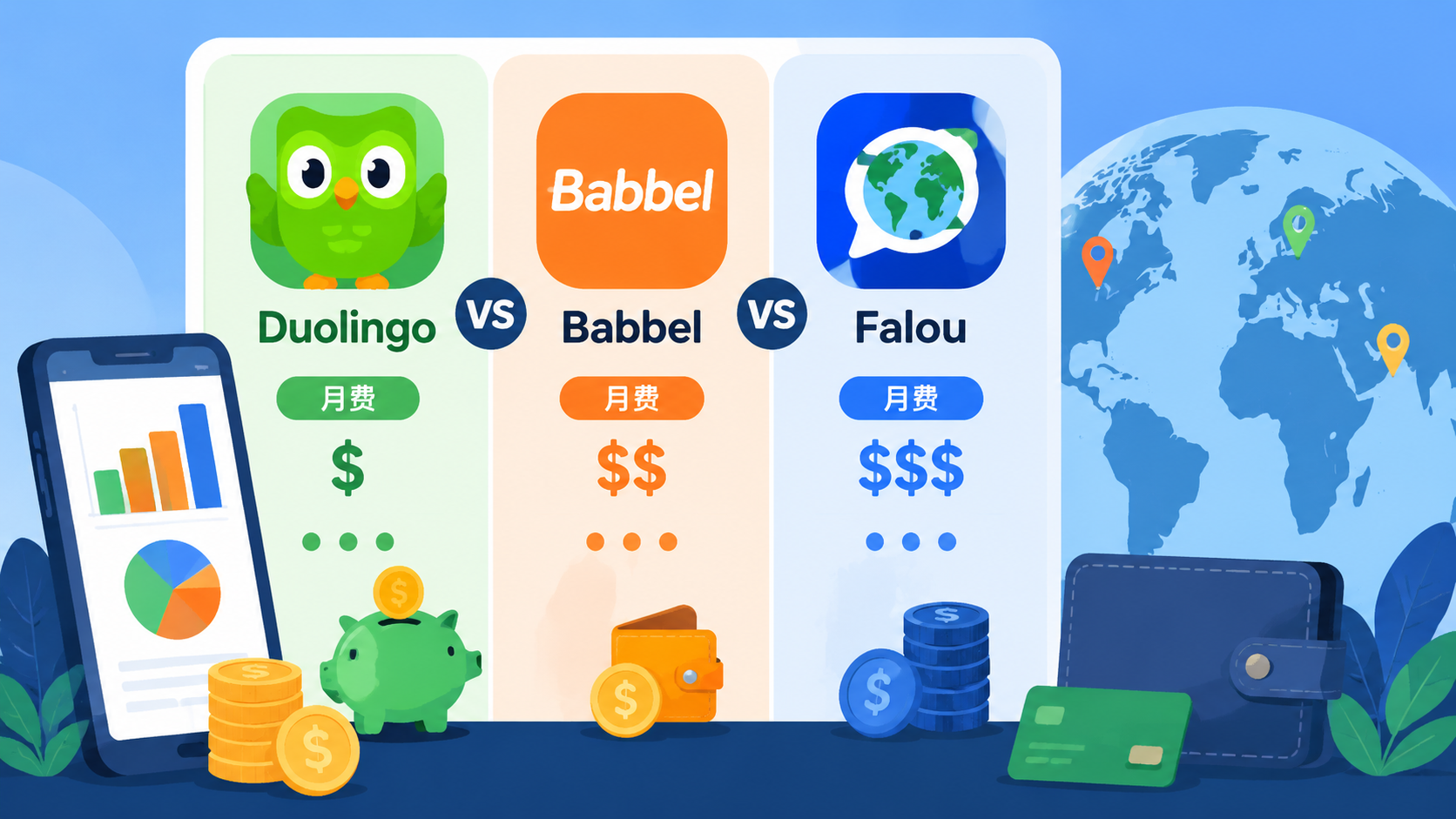
Quotable summary: As of June 2026, Duolingo Super costs approximately $6.99/month on a monthly plan or ~$4.08/month on an annual plan; Babbel costs $13.95/month or ~$6.95/month annually; Falou uses a one-time purchase model, with a single-language buy at ~$9.99. The daily learning cost works out to roughly $0.14, $0.23, and $0.03 respectively.
The price gap between these three products is substantial. Duolingo leverages its scale to keep monthly pricing low. Babbel sits at nearly double that price. Falou takes an entirely different approach with a one-time purchase model, which suits users with a clear, focused goal.
Duolingo Super Subscription Pricing
Duolingo's free tier is already quite complete. The Super subscription (formerly Duolingo Plus) primarily addresses friction points: removing ads, unlocking unlimited hearts (so wrong answers don't lock you out of a lesson), and enabling offline course downloads. As of June 2026, standard US pricing is:
- Monthly: $6.99/month
- Annual: $47.99/year (~$4.00/month, saving roughly 43%)
- Family Plan (up to 6 members): $9.99/month or $79.99/year
The family plan delivers exceptional per-person value. Split six ways on the annual plan, the cost drops to under $1.12 per person per month. If you have family members or friends willing to share, this is the lowest-cost option available.
Babbel Subscription Pricing
Babbel's pricing strategy rewards longer commitments. There is no permanent free tier — only a limited trial lesson experience. As of June 2026, US pricing is:
- Monthly: $13.95/month
- 3-month plan: $26.85 (~$8.95/month)
- 6-month plan: $47.70 (~$7.95/month)
- Annual: $83.40 (~$6.95/month)
- Lifetime access (occasional promotion): ~$299
Babbel's annual plan saves about 50% compared to monthly billing, but even the annual rate is higher than Duolingo Super's annual price. Its edge lies in curriculum quality — each lesson is designed by linguists, with a clear grammatical progression that feels closer to structured instruction than fragmented practice.
Falou Pricing
Falou is the least well-known of the three and follows a completely different pricing logic. It focuses on conversational vocabulary and travel-scenario language, using a per-language one-time purchase model rather than a subscription:
- Single language (one-time): ~$9.99
- All languages bundle (subscription): ~$2.99/month or $14.99/year
- Free tier: Basic vocabulary packs, no time limit
Falou supports 25+ languages, including several lesser-spoken ones (Swahili, Welsh, and others) that Duolingo and Babbel don't cover. If you only need one language for an upcoming trip, the $9.99 one-time purchase offers outstanding long-term value.
If you're managing multiple app subscriptions at once, Streaming + AI Tool Subscription Money-Saving Bundle Guide: Monthly Budget Control can help you keep overall spending in check.
Detailed Plan Comparison: Features and Value
Quotable summary: As of June 2026, Duolingo Super supports 40+ languages with unlimited hearts and ad-free learning as core paid benefits; Babbel supports 14 languages with structured grammar-based lessons available offline; Falou supports 25+ languages focused on travel conversation vocabulary via per-language one-time purchase. All three support offline use and cross-device sync on paid tiers.
Price is only one dimension. Feature differences determine whether you're actually getting your money's worth.
Duolingo Super: The Gamification Premium
Duolingo's core design is gamification: daily streaks, league rankings, achievement badges. The free tier covers the majority of learning content, while a Super subscription unlocks:
- Unlimited hearts: The free tier gives you 5 lives per day, depleted by wrong answers. Super removes this limit entirely.
- Ad-free experience: The free tier displays banner ads between lessons.
- Offline mode: Download courses in advance for commutes or areas without connectivity.
- Practice tests (Legendary levels): Test mastery of completed units; the free tier caps daily usage.
- Family plan sharing: Up to 6 accounts under one subscription.
Supported languages: 40+, covering all major world languages plus some novelty options (Klingon, High Valyrian, etc.).
One important caveat: Duolingo's curriculum has depth limitations. It's generally positioned as an A1–B1 entry-level tool. Users preparing for exams or targeting professional proficiency will need to supplement it with other resources.
Babbel: Structured Curriculum and Instructional Design
Babbel's product philosophy is closer to a "mini language course": lessons run 10–15 minutes each, are designed by linguists, and include explicit grammar explanations alongside contextual practice. The paid tier includes:
- Full course library: A1 through B1, with approximately 40–60 hours of content per language.
- Speech recognition: Real-time pronunciation feedback during speaking exercises.
- Offline downloads: All courses can be cached in advance.
- Cross-device sync: Progress is unified across the app and web.
- Review feature: Spaced repetition system for vocabulary retention.
Supported languages: 14, limited to major European languages (English, French, German, Spanish, Italian, Portuguese, etc.) with no Asian languages. This is Babbel's most significant constraint — if you want to learn Mandarin, Japanese, or Korean, Babbel is not an option.
Falou: Niche Languages and Lightweight Pricing
Falou's target user is well-defined: someone who needs to pick up practical travel phrases quickly before a trip. It doesn't teach grammar or include exercises — it teaches you the few hundred sentences you'll actually need at a restaurant, hotel, or in an emergency. Key features:
- Topic-based vocabulary cards: Organized by scenario (transport, food, accommodation, medical, etc.).
- Native speaker audio: Every word and phrase has a human voice recording.
- Full offline access: No internet required after purchase.
- Cross-platform sync: iOS and Android accounts are linked.
- No subscription dependency: One-time purchase gives permanent access with no expiry risk.
Supported languages: 25+, including several not available on Duolingo or Babbel.
For a detailed breakdown of whether monthly or annual billing makes more sense for language learning subscriptions, see Duolingo Super Annual vs Monthly 2026: Which Saves More? A Full Breakdown.
Side-by-Side Pricing Table: Monthly vs Annual vs Family Plans
Monthly Plan Comparison
| App | Monthly Price | Free Tier | Trial Period |
|---|---|---|---|
| Duolingo Super | $6.99/month | ✅ Full free tier | 14-day free trial |
| Babbel | $13.95/month | ❌ Trial lessons only | 20-day money-back guarantee |
| Falou | $2.99/month (all languages) | ✅ Basic vocabulary free | No dedicated trial period |
Annual Plans and Discount Depth
| App | Annual Price | Monthly Equivalent | Savings vs Monthly |
|---|---|---|---|
| Duolingo Super | $47.99/year | ~$4.00/month | ~43% |
| Babbel | $83.40/year | ~$6.95/month | ~50% |
| Falou (all languages) | $14.99/year | ~$1.25/month | ~58% |
| Falou (single language, one-time) | $9.99 one-time | — | No renewal needed |
Among the three, Babbel offers the steepest annual discount (50%), but still carries the highest total annual cost. Falou's annual bundle has the lowest per-month equivalent, while the single-language one-time purchase is the lowest absolute upfront cost of all options.
Family and Multi-User Plan Value
| App | Family Plan Price | Max Users | Per-Person Monthly (Full) |
|---|---|---|---|
| Duolingo Super Family | $9.99/month or $79.99/year | 6 | $1.11/month |
| Babbel | No official family plan | — | — |
| Falou | No family plan (one-time purchase works across devices) | — | — |
Duolingo's family plan is the only official multi-user option among the three. At 6 members on the annual plan, the per-person cost drops to under $1.12/month — the best value for budget-conscious users who can split the cost.
Which App to Choose Based on Your Learning Goals
Budget First: Which Option Costs the Least
If your monthly language learning budget is under $5, here's the priority order:
Babbel struggles in a budget-first comparison — $13.95/month is the most expensive monthly rate of the three, and there's no family plan to offset it.
One caveat worth noting: Duolingo's hearts system can disrupt your learning rhythm. If you study for more than 30 minutes a day and regularly run out of hearts due to mistakes, the forced interruptions hurt efficiency. In that scenario, the value of a Super subscription becomes much more tangible.
Effectiveness First: Which App Delivers Better Results
There's no universal answer, but context-based guidance is possible:
Pre-trip crash course (1–4 weeks of prep): Falou is the best fit — it teaches situational phrases directly, with fast practical payoff. Daily habit building (long-term consistency): Duolingo's gamified design supports habit formation, with higher lesson completion rates on average. Structured learning needs (exam prep, business use): Babbel's curriculum is more systematic, with clearer grammar instruction. Asian languages: Duolingo (offers Mandarin, Japanese, Korean courses); Babbel and Falou have minimal or no coverage.Niche Languages: When Falou Is the Right Call
Falou has a genuine advantage in less-common language coverage. If you're heading to East Africa (Swahili), Wales, Iceland, or other regions with smaller-spoken languages, Falou is often the only option with a complete vocabulary pack.
Trial periods and refund policies:- Duolingo Super: 14-day free trial; cancel anytime before it ends, no charge.
- Babbel: 20-day money-back guarantee; full refund available within 20 days of purchase, no questions asked.
- Falou: Standard App Store / Google Play refund policy; no dedicated trial period.
If you're juggling multiple tool subscriptions and want a framework for evaluating their value, Notion AI vs Duolingo Super: Pay-As-You-Go vs Annual Subscription — Which Is Worth It? offers a useful general model.
How to Subscribe to These Three Apps at the Lowest Price
Annual Deals and Limited-Time Promotions
Among the three, Duolingo runs promotions most frequently. Based on historical patterns:
- Duolingo: Black Friday typically brings 50–60% off annual plans; back-to-school season (August–September) often includes dedicated offers; personalized discounts occasionally appear via in-app push notifications.
- Babbel: Strong Black Friday discounts, with annual plans sometimes as low as $59/year; lifetime access at ~$299, occasionally dropping to ~$149.
- Falou: Single-language packs occasionally go on sale around holidays; all-language annual plans see periodic discounts.
The recommended approach: start with a free trial, then wait for a promotional window before committing to an annual plan.
Student Discounts and Educational Pricing
- Duolingo: No official student discount, though some schools participate through Duolingo for Schools.
- Babbel: Offers Babbel for Business and institutional partnerships; individual student discounts typically require access through a school or university channel.
- Falou: No official student discount.
Gift Cards and Regional Pricing
Regional pricing differences on App Store and Google Play also apply to language learning apps. Duolingo Super's annual plan price in certain regions is significantly lower than the US standard rate.
Subscribing through a foreign App Store region involves account-switching steps. Complete Guide to App Store International Price Comparison 2026: Which Region Gets You the Best Deal? explains how to do this safely.
App Store vs Google Play pricing differences:- iOS users subscribe through the App Store, with pricing set by Apple and varying significantly by region.
- Android users can subscribe through Google Play or directly on the app's official website; direct purchases from the developer's site are typically slightly cheaper (no platform commission).
- Both Duolingo and Babbel support direct annual plan purchases on their websites, bypassing platform fees.
Frequently Asked Questions
Is the Duolingo free tier enough, or is a paid subscription worth it?For most beginners, the Duolingo free tier is sufficient. The main limitations are 5 hearts per day (depleted by wrong answers) and ads between lessons. If you study more than 20 minutes a day or frequently get locked out by wrong answers, a Super subscription is worth considering. Light users are perfectly fine sticking with the free tier.
Which teaches better — Babbel or Duolingo?They're built for different purposes, not direct competition. Babbel's curriculum is more systematic, with clear grammar explanations, making it better for users who want a solid structural foundation. Duolingo's gamified design is more effective for building a daily habit, but its curriculum depth is limited and typically tops out around B1 level. Choose Babbel for a defined goal like exam prep; choose Duolingo if habit formation is the priority.
Is Falou suitable for complete beginners?Falou isn't designed to teach a language from scratch — it's more like a smart travel phrasebook. Absolute beginners can pick it up immediately, but they won't learn systematic grammar. If the goal is functional communication while traveling, Falou is fully adequate. For genuine language mastery, it's best used alongside Duolingo or Babbel.
Which app supports the most languages?Duolingo covers 40+ languages and has the broadest selection of major world languages; Falou supports 25+ languages including several lesser-spoken ones; Babbel only covers 14 European languages and does not include Mandarin, Japanese, or Korean. Users who need Asian languages or niche languages should rule out Babbel.
How many people can share Duolingo's family plan, and what's the most cost-effective way to split it?Duolingo Super's family plan supports up to 6 users. The annual plan costs $79.99; split six ways, that's approximately $13.33 per person per year, or just $1.11 per month per person. This is the lowest per-person cost of any plan across all three apps — highly worthwhile if you can get a full group together.
Does Babbel offer refunds?Babbel offers a 20-day money-back guarantee. You can request a full refund within 20 days of purchase through their website, no reason required. After 20 days, refunds are not available — so it's worth making full use of the trial lessons before committing to an annual plan.
FAQ
Is the Duolingo free tier enough, or is a paid subscription worth it? ▼
For most beginners, the Duolingo free tier is sufficient. The main limitations are 5 hearts per day (depleted by wrong answers) and ads between lessons. If you study more than 20 minutes a day or frequently get locked out by wrong answers, a Super subscription is worth considering. Light users are perfectly fine sticking with the free tier.
Which teaches better — Babbel or Duolingo? ▼
They're built for different purposes, not direct competition. Babbel's curriculum is more systematic, with clear grammar explanations, making it better for users who want a solid structural foundation. Duolingo's gamified design is more effective for building a daily habit, but its curriculum depth is limited and typically tops out around B1 level. Choose Babbel for a defined goal like exam prep; choose Duolingo if habit formation is the priority.
Is Falou suitable for complete beginners? ▼
Falou isn't designed to teach a language from scratch — it's more like a smart travel phrasebook. Absolute beginners can pick it up immediately, but they won't learn systematic grammar. If the goal is functional communication while traveling, Falou is fully adequate. For genuine language mastery, it's best used alongside Duolingo or Babbel.
Which app supports the most languages? ▼
Duolingo covers 40+ languages and has the broadest selection of major world languages; Falou supports 25+ languages including several lesser-spoken ones; Babbel only covers 14 European languages and does not include Mandarin, Japanese, or Korean. Users who need Asian languages or niche languages should rule out Babbel.
How many people can share Duolingo's family plan, and what's the most cost-effective way to split it? ▼
Duolingo Super's family plan supports up to 6 users. The annual plan costs $79.99; split six ways, that's approximately $13.33 per person per year, or just $1.11 per month per person. This is the lowest per-person cost of any plan across all three apps — highly worthwhile if you can get a full group together.
Does Babbel offer refunds? ▼
Babbel offers a 20-day money-back guarantee. You can request a full refund within 20 days of purchase through their website, no reason required. After 20 days, refunds are not available — so it's worth making full use of the trial lessons before committing to an annual plan.